
The Hot Tub Shock Protocol: Why You Need to Shock Your Spa Weekly and Exactly How to Do It
Shocking your hot tub is not the same as sanitizing it. Here is what shock actually does, why it is non-negotiable in any maintenance system, and the exact weekly protocol for both chlorine and bromine spas.
THE ROUTINE
6 min read
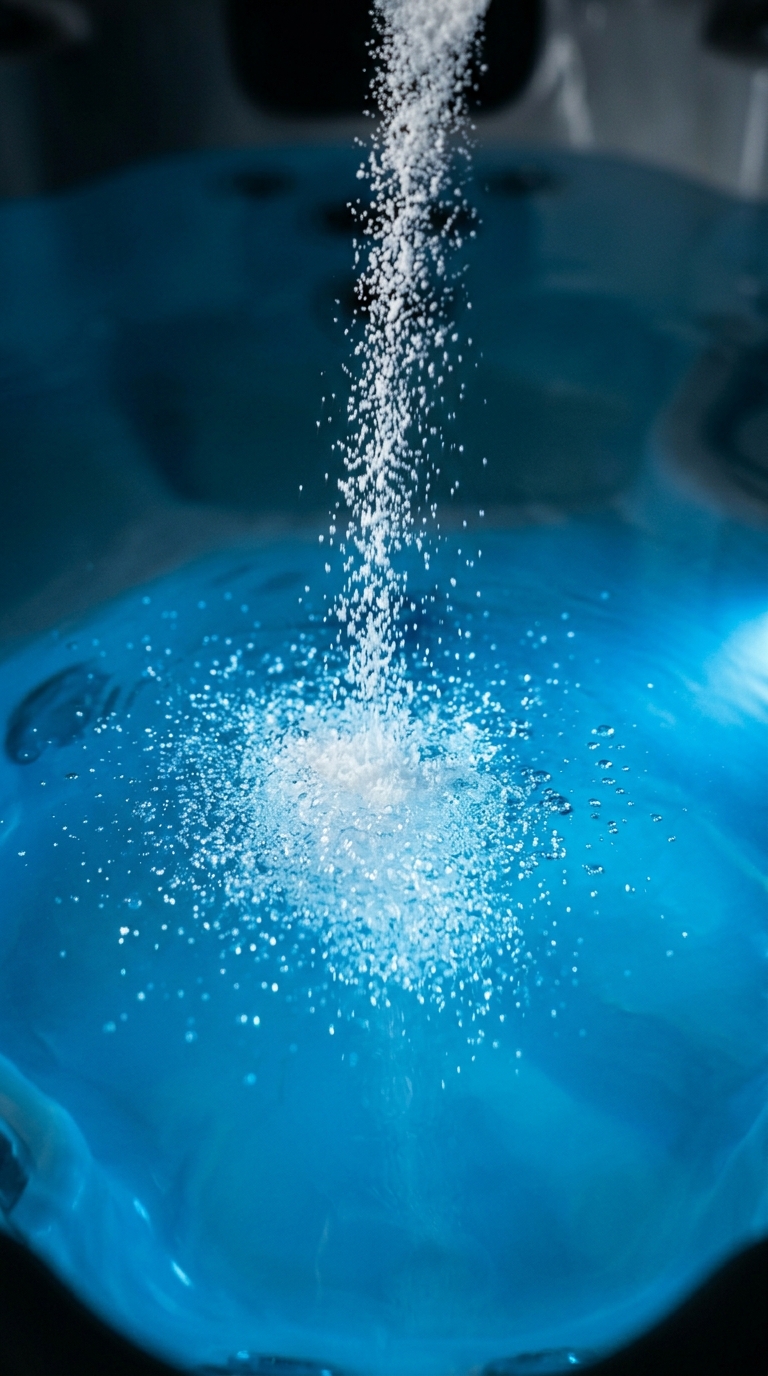
The most common hot tub maintenance misconception is that shocking the water is something you do when there is a visible problem — cloudy water, a chemical smell, or a sanitizer reading that will not recover. In reality, shocking is something you do every single week regardless of how the water looks, smells, or tests. The water can have a correct free chlorine reading, clear visual appearance, and no detectable odour and still urgently need to be shocked. Understanding why requires understanding what shock actually does — and what sanitizer alone cannot.
Sanitizer kills bacteria and biological contamination in the water. What it cannot do efficiently is break down the organic byproducts of its own activity. Every time free chlorine reacts with bather waste — body oils, skin cells, urine traces, sweat, cosmetic residue — it forms combined chlorine compounds called chloramines. Chloramines are the source of the sharp chemical smell most people associate with over-chlorinated water. That smell is not the result of too much chlorine. It is the result of too little — specifically too little free chlorine to handle the organic load, producing chloramines faster than the sanitizer system can process them. Shock oxidizes and eliminates these compounds, restoring the free chlorine reserve to its full operational efficiency and eliminating the odour at its source.
For bromine spas, the dynamic is slightly different but the weekly shock requirement is identical. Bromamines — the bromine equivalent of chloramines — accumulate in bromine-treated water and degrade water quality and sanitizer efficiency in exactly the same way. The weekly shock cycle oxidizes bromamines, reactivates the bromide bank, and restores full bromine effectiveness.
Phase 1: Understanding Shock — Oxidizer vs. Sanitizer
Shock and sanitizer are two distinct products performing two distinct functions in a hot tub maintenance system. Using one in place of the other, or relying on one without the other, produces a maintenance gap that compounds over time into persistent water quality problems.
Sanitizer — chlorine or bromine — is the active biological protection in the water. It kills pathogens on contact and maintains a residual concentration that continues killing contamination between doses. It works continuously and is consumed continuously by the organisms and organic material it contacts.
Shock — specifically non-chlorine oxidizer for spa use — is a chemical oxidizer, not a sanitizer. It does not kill pathogens directly. What it does is chemically break apart the complex organic compounds that accumulate in the water — the chloramines, bromamines, body waste byproducts, and dissolved organics that your sanitizer produced as reaction byproducts or was unable to fully process. By eliminating these compounds, shock restores the efficiency of the active sanitizer in the water, clears the chemical odour they produce, and prevents the build-up that leads to persistent cloudiness and water quality degradation.
Why non-chlorine shock for spas: Chlorine shock — also called calcium hypochlorite or dichlor shock — is the standard shock product for swimming pools. In a hot tub, non-chlorine shock is almost always the correct product for the weekly maintenance cycle for two reasons. First, non-chlorine shock does not add to your chlorine or cyanuric acid levels, keeping those parameters stable between weekly tests. Second, non-chlorine shock allows re-entry within 15 to 20 minutes of application — chlorine shock requires a wait time of several hours until the spike dissipates, making it impractical for a spa used on a daily schedule. Non-chlorine shock is the correct maintenance shock product for both chlorine and bromine hot tub systems.
Phase 2: The Weekly Shock Protocol
The weekly shock is a fixed event in your maintenance calendar — not a reactive response to a problem. Execute it on the same day as your weekly anchor test so that the test informs any chemistry corrections needed before the shock is applied, and the shock completes the full weekly maintenance cycle in a single session.
Timing — Shock After Use, Not Before: Execute the weekly shock after the last use session of the day rather than before the tub is used. Shock works best with the cover off and jets running to allow the oxidizer to circulate fully and any off-gassing to dissipate. Adding shock before a use session and then replacing the cover traps off-gassing under the cover and reduces the effectiveness of the oxidation cycle.
The Application: With jets running at full circulation, add the non-chlorine shock dose calculated for your tub's water volume directly to the water with the cover removed. For most residential hot tubs in the 300 to 500 gallon range, a standard weekly maintenance dose is the amount specified on your product packaging for that volume — typically one to two tablespoons of granular non-chlorine shock per 300 gallons. Distribute the dose around the perimeter of the tub rather than dumping it in one location. Pre-dissolving in a cup of warm water before addition ensures even distribution and prevents any localised concentration at the point of addition.
Post-Application Protocol: Run the jets with the cover off for 20 minutes after shock application. This circulates the oxidizer through the full water volume, allows surface off-gassing to dissipate, and prevents the cover from trapping chemical vapour. After 20 minutes replace the cover and allow the tub to complete the oxidation cycle undisturbed overnight. The water will be at its cleanest and most chemically efficient the following morning.
The Retest: Execute a quick test strip check on free chlorine or bromine the morning after a weekly shock to confirm that sanitizer levels are holding within the operational range. A well-maintained spa with correct chemistry should show stable or slightly elevated sanitizer readings the morning after a shock — the restored oxidative environment gives the active sanitizer less organic load to fight, allowing it to hold higher effective concentrations between doses.
Phase 3: The Heavy-Use Shock Protocol
The standard weekly shock cycle is designed for a residential spa with moderate use — two to four bathers, three to five sessions per week. High-use scenarios require a more responsive shock protocol because the organic load introduced by heavy bather use accumulates faster than a weekly cycle can process.
The Post-Session Oxidation Dose: After any session involving four or more bathers, add a half-maintenance dose of non-chlorine shock immediately after the session ends with the jets running and cover off for 15 minutes. This mid-cycle oxidation dose processes the acute organic load from the heavy session before it compounds with the existing water chemistry and begins producing chloramines or bromamines at an accelerated rate. It does not replace the weekly full shock — it supplements it between weekly cycles in high-demand scenarios.
The Cloudy Water Response: If the water develops unexpected cloudiness between weekly shock cycles, execute an immediate full shock dose rather than adding clarifier as the first response. Clarifier coagulates suspended particles but does not address the dissolved organic load that most commonly produces mid-week cloudiness in a high-use spa. If the water clears within two hours of shocking, the cloudiness was organic in origin and the shock resolved it. If the water remains cloudy after shocking, the cloudiness has a different cause — likely a filtration or chemistry parameter issue — and a clarifier and full chemistry test are the correct next steps.
The Cover-Off Ventilation Rule: In a high-use household where the spa is used multiple times per day, ensure the cover is removed for at least 30 minutes once daily to allow surface ventilation and off-gassing even on days when shock is not applied. A continuously covered spa in heavy use traps chemical vapours under the cover and creates an accelerated chloramine and bromamine build-up environment that makes the weekly shock cycle progressively less effective at restoring water quality.
Phase 4: The Bromine System Shock Protocol
The bromine shock protocol requires one additional step that the chlorine system does not — bromide bank reactivation. This makes the weekly shock more important in a bromine spa than in a chlorine spa, not less.
The Bank Reactivation Sequence: When you shock a bromine spa with non-chlorine oxidizer, the oxidizer activates the bromide bank — converting stored sodium bromide ions into active bromine sanitizer. This is the primary mechanism by which a bromine spa maintains its sanitizer residual between tablet doses. If the weekly shock is skipped, the bromide bank is not reactivated, active bromine levels drop, and tablet consumption appears to increase because the bank is not being continuously refreshed. Most bromine spa owners who experience difficulty maintaining bromine levels are skipping or inconsistently executing the weekly shock, not running out of tablets.
The Activation Confirmation: After shocking a bromine spa, test active bromine levels two hours after application. The reading should show a measurable increase from the pre-shock baseline — the direct result of the oxidizer activating the bromide bank. If the post-shock reading does not increase, the bromide bank may be depleted and requires a maintenance dose of sodium bromide before the next shock cycle to re-establish the reserve.
The Expert Gear List
To execute a complete weekly hot tub shock protocol for both maintenance and high-use scenarios, our team deploys the following products. All items are available on Amazon.
Disclosure: The Retrofit Routine is a participant in the Amazon Services LLC Associates Program. As an Amazon Associate, we earn from qualifying purchases at no additional cost to you.
Non-Chlorine Shock
AquaDoc Non-Chlorine Hot Tub Shock — 32oz: A high-efficiency spa oxidizer engineered to rapidly eliminate chloramines and bromamines, restoring sanitizer effectiveness and clarifying cloudy water. This fast-acting formula allows for safe re-entry within 15 to 20 minutes of application and is fully compatible with all spa types and both chlorine and bromine systems.
Also available in 32oz(2-pack) and 5lb bag option depending on your frequency:
Contact
Questions? Reach out anytime, we’re here.
© 2026. All rights reserved.
Disclosure
The Retrofit Routine is a participant in the Amazon Services LLC Associates Program. As an Amazon Associate, we earn from qualifying purchases at no additional cost to you.
The Retrofit Routine is a digital property owned and operated by Atlantic Delivery Drivers Corp.