
The Pool Chemistry Balancing Protocol: How to Correct pH, Alkalinity, and Cyanuric Acid in the Right Sequence
Your weekly pool test came back out of range. Here is the exact correction sequence for every parameter — what to add, how much, in what order, and why deviating from the sequence guarantees you will be correcting your corrections for the rest of the week.
THE ROUTINE
9 min read
Running a weekly pool water test is the diagnostic step. Knowing precisely what to do with the results is the operational step — and this is where most pool owners lose time, money, and water quality. The correction sequence is not arbitrary. Every parameter in pool water chemistry interacts with every other parameter, and adding products in the wrong order produces false readings that drive incorrect follow-up doses, instability that compounds across the week, and the recurring chemistry cycle that makes pool management feel like a losing battle.
The most common version of this failure looks like this: the pH reads high so pH decreaser is added. The pH corrects. Two days later the pH is high again. More pH decreaser is added. This cycle continues indefinitely because the root cause — low total alkalinity that is allowing the pH to drift uncontrolled — was never addressed. The pH corrector is doing its job. The problem is that pH correction applied to water with inadequate alkalinity never holds, because alkalinity is the chemical buffer that prevents pH from moving in the first place.
Pool chemistry correction requires a fixed, non-negotiable sequence: alkalinity stabilizes first, pH corrects second, calcium hardness corrects third, cyanuric acid corrects fourth, and sanitizer is added last. Every product added out of this sequence either produces a result that does not hold or actively interferes with the effectiveness of the product that should have come before it.
This guide is the complete pool chemistry correction reference — the exact sequence, the exact products, the dosing approach for each parameter, and the retest protocol that confirms every correction has held before the next is executed.
Phase 1: The Correction Sequence — Why Order Is the Protocol
Before touching a single product, the sequence must be understood. This is not a preference — it is the chemical reality of how these parameters interact in the same body of water.
Total Alkalinity Corrects First: Alkalinity is the buffer system that stabilizes pH. In water with alkalinity below 80 ppm, pH has no buffer holding it in position — it responds to every input with a large swing. Rain drives it down. Bather load drives it up. Chemical additions produce overshoots in both directions. No amount of pH correction produces a stable result in water with inadequate alkalinity. You are filling a bucket with the drain open. Correct alkalinity first and the pH becomes predictable, responsive, and stable.
pH Corrects Second: Once alkalinity is confirmed within the 80 to 120 ppm range, pH correction holds. The 7.4 to 7.6 window is not arbitrary — at pH above 7.8, free chlorine effectiveness drops to less than 20% of its rated value regardless of the concentration. At pH below 7.2, water becomes corrosively aggressive against pool surfaces, grout, metal fittings, and swimmer skin and eyes. Within the 7.4 to 7.6 window, chlorine operates at maximum efficiency and water is compatible with every surface and every person it contacts.
Cyanuric Acid Corrects Third: CYA — the chlorine stabilizer — is corrected after pH because its dissolution rate and testing accuracy are affected by pH values outside the correct range. More critically, adding chlorine sanitizer to an outdoor pool with CYA below 30 ppm wastes the sanitizer investment — UV radiation destroys unprotected chlorine within hours in direct summer sun. CYA correction happens before sanitizer is added because without adequate CYA the sanitizer dose is gone before it has had time to do meaningful work.
Sanitizer Adds Last: Free chlorine added to water with correct alkalinity, correct pH, and adequate CYA binds to the CYA molecule partially and is released gradually as the free residual is consumed — extending the effective life of the sanitizer significantly compared to unprotected chlorine in water with poor chemistry foundations.
Never Add Two Products Simultaneously: Always circulate for a minimum of 30 minutes and retest the corrected parameter before adding the next product. Two correction products added at the same time produce chemical interactions in the water that make accurate retesting impossible and can drive the corrected parameter in an unexpected direction.
Phase 2: Alkalinity Correction
Total alkalinity governs the stability of every other parameter. Without it in range, nothing else holds. Target range is 80 to 120 ppm for a standard residential pool.
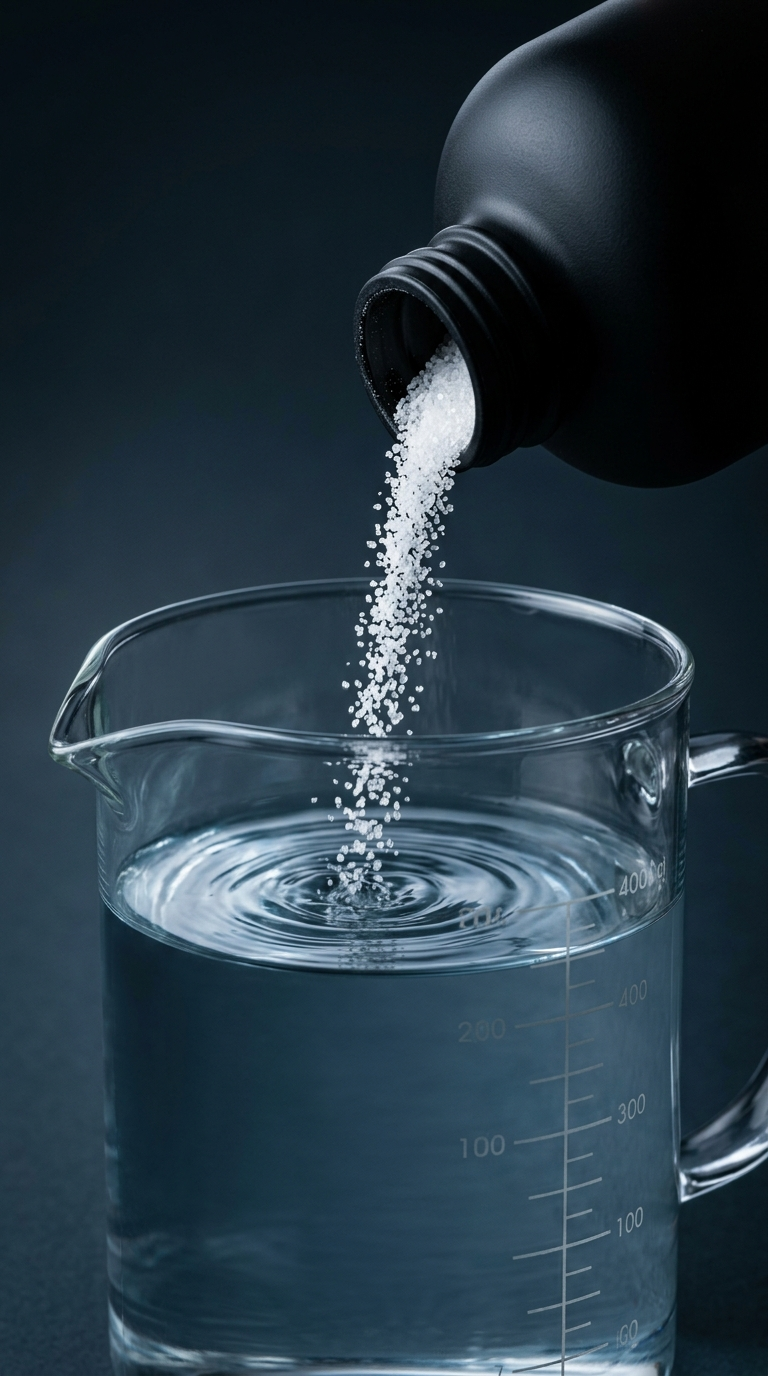
Low Alkalinity — Below 80 ppm: Add the alkalinity increaser in calculated increments based on your pool volume. As a general reference, approximately 1.5 pounds of sodium bicarbonate raises total alkalinity by 10 ppm in a 10,000 gallon pool. Pre-dissolve the product in a bucket of pool water before distributing evenly around the pool perimeter with the pump running. Never dump the full calculated dose at once — alkalinity rises quickly and overshooting the 120 ppm upper limit requires an acid addition to correct downward, which simultaneously affects pH and creates an additional correction cycle. Add in increments of no more than 10 ppm per dose, circulate for 30 minutes, and retest before adding more.
High Alkalinity — Above 120 ppm: High alkalinity makes pH resistant to correction and contributes to scale formation on pool surfaces and in the heater. Lower alkalinity by adding pH decreaser in small increments with the pump running and the jets directed toward the surface to maximize aeration. Work in multiple small doses spread across several hours rather than targeting the full correction in a single treatment. The aeration from running the pump with the water agitated helps off-gas the dissolved carbonates that contribute to high alkalinity.
The Alkalinity Confirmation: Before proceeding to pH correction, confirm the alkalinity reading is within the 80 to 120 ppm range on a retest executed at least 30 minutes after the final correction dose with the pump running continuously.
Phase 3: pH Correction
With alkalinity stabilized, pH correction holds. Target range is 7.4 to 7.6. This is a deliberately narrow window — the 7.4 to 7.6 band is where every other chemistry decision in the pool delivers its full rated effectiveness.
High pH — Above 7.6: High pH is the more common correction requirement, particularly in pools that experience significant rainfall, heavy bather load, or use of calcium hypochlorite shock which drives pH upward. Add pH decreaser containing sodium bisulfate in small increments — as a general reference approximately 6 ounces lowers pH by 0.2 points in a 10,000 gallon pool, though this varies with current alkalinity level. Pre-dissolve in a bucket of pool water before adding near a return jet with the pump running. Allow full circulation for 20 minutes and retest before adding more. pH decreaser also lowers alkalinity — if alkalinity is already at the lower end of the correct range, add pH decreaser in smaller increments and retest both parameters between additions.
Low pH — Below 7.4: Low pH produces aggressive, corrosive water. Add pH increaser containing sodium carbonate in small increments. Pre-dissolve before adding near the return jets. pH rises quickly in response to sodium carbonate — add conservatively, circulate for 20 minutes, and retest. The most common low-pH scenario follows a heavy acid rain event or over-application of pH decreaser from a previous correction cycle. In both cases the alkalinity will also have been affected and should be retested simultaneously.
The pH Confirmation: Confirm pH is reading within 7.4 to 7.6 on a retest before proceeding to cyanuric acid correction.
Phase 4: Cyanuric Acid — The Outdoor Pool Stabilizer
Cyanuric acid is the parameter most frequently overlooked in residential pool chemistry management and one of the most consequential for running costs and chlorine efficiency. Target range is 30 to 50 ppm for an outdoor chlorine pool.
Low CYA — Below 30 ppm: An outdoor pool with CYA below 30 ppm is losing a significant percentage of its free chlorine to UV degradation every hour of direct sun exposure. The pool consumes significantly more chlorine per week than the same pool with adequate CYA — the chlorine is simply being destroyed by sunlight faster than the sanitizer system was designed to replenish it. Add cyanuric acid stabilizer by pouring it directly into the skimmer with the pump running — CYA dissolves slowly and the skimmer provides the most even distribution method. Do not pour CYA directly into the pool — it can settle and concentrate on plaster surfaces and produce localized bleaching. Allow 24 to 48 hours for CYA to fully dissolve and distribute before testing for the stabilized reading, as the dissolution rate is slower than most other pool chemicals. Do not add the chlorine maintenance dose until the CYA reading has stabilized — chlorine added before adequate CYA is established will be destroyed within hours in direct sun.
High CYA — Above 80 ppm: High CYA suppresses chlorine effectiveness through a phenomenon known as chlorine lock — the CYA binds a disproportionate percentage of the free chlorine, reducing the active free residual even when the total chlorine reading appears adequate. Unlike every other chemistry parameter, high CYA cannot be corrected with a chemical addition. The only correction is dilution — partially draining the pool and refilling with fresh water to reduce the CYA concentration. Drain 25% to 30% of the pool volume, refill with fresh water, and retest before adding any additional chlorine or stabilizer.
The Overstabilization Prevention Protocol: CYA is not consumed by normal pool operation the way chlorine is — it accumulates with every dose of stabilized chlorine products such as trichlor tabs and dichlor granules, which contain cyanuric acid as a component. Pools using stabilized chlorine products as their primary sanitizer will see CYA levels climb through the season without any dedicated stabilizer additions. Test CYA monthly and track the trend — a pool approaching 60 ppm on stabilized chlorine should switch to unstabilized calcium hypochlorite for the remainder of the season to prevent drift toward the chlorine lock threshold.
Phase 5: The Chlorine Neutralizer — The Emergency Chemistry Reset
A chlorine and bromine neutralizer — sodium thiosulfate — is the product that every pool owner should have on hand but most never purchase until the moment they need it. Its role is not routine maintenance. It is an emergency correction tool for two specific scenarios.
Scenario 1 — Accidental Over-Chlorination: A measurement error, a stuck feeder, or a miscalculated shock dose can leave the pool with free chlorine levels significantly above the safe swimming range. At concentrations above 10 ppm, the pool is not swimmable and the elevated chlorine will continue degrading CYA and affecting water balance while it slowly burns off through normal dissipation. Sodium thiosulfate reduces free chlorine concentration immediately and precisely, restoring swimmable levels within hours rather than waiting days for natural dissipation.
Scenario 2 — Sanitizer System Switch: A household switching from a chlorine to a bromine sanitizer system — or vice versa — must neutralize the existing sanitizer residual before introducing the new system. Residual chlorine introduced into a bromine system and residual bromine introduced into a chlorine system both produce chemistry interactions that destabilize the new system from its first dose. Neutralizing the existing residual completely before adding the first dose of the new sanitizer is the correct protocol for any sanitizer system transition.
The Neutralizer Dosing Protocol: Add sodium thiosulfate in small calculated increments — the product works rapidly and over-application will drive free chlorine below the minimum protective level, leaving the pool biologically unprotected. Add at the dose specified for your target chlorine reduction, circulate for 10 minutes, and retest before adding more. Never add neutralizer and shock simultaneously — neutralizer applied immediately before or after a shock dose simply negates the shock treatment and wastes both products.
The Expert Gear List
To execute complete pool chemistry corrections across all parameters, our team deploys the following products. All items are available on Amazon.
Disclosure: The Retrofit Routine is a participant in the Amazon Services LLC Associates Program. As an Amazon Associate, we earn from qualifying purchases at no additional cost to you.
Alkalinity Correction
AquaDoc Pool Alkalinity Increaser — 5lb, 10lb: Sodium bicarbonate-based alkalinity increaser for raising total alkalinity in pools testing below the 80 ppm threshold. The foundational correction product that must be executed before any pH adjustment in a complete chemistry correction sequence — stabilizing alkalinity is what makes every subsequent correction hold. Pre-dissolve before adding, dose in increments, and retest before proceeding to pH correction. Compatible with all pool types and all sanitizer systems.
pH Correction
AquaDoc pH Down for Pools — 5lb: Sodium bisulfate formula for lowering elevated pH in residential pools. Fast-dissolving, pre-dissolvable for controlled dose distribution. The correct product for any correction where pH reads above 7.6. Note that pH decreaser also lowers alkalinity — dose conservatively and retest both parameters between additions. Compatible with all pool types and sanitizer systems.
Also available in 10lb for larger pools:
AquaDoc pH Up for Swimming Pools — 5lb, 10lb: Sodium carbonate formula for raising low pH in residential pools. Fast-dissolving, compatible with all pool types and sanitizer systems. The correct product for any correction where pH reads below 7.4 or where acidic water conditions are causing surface or equipment corrosion. Pre-dissolve before adding near the return jets and retest after 20 minutes of circulation before adding more.
Cyanuric Acid Stabilizer
AquaDoc Pool Stabilizer and Conditioner — 5lb, 10lb: Cyanuric acid stabilizer for protecting free chlorine from UV degradation in outdoor pools. Add through the skimmer with the pump running — never directly to the pool surface. Allow 24 to 48 hours for full dissolution before testing the stabilized reading. The product that reduces chlorine consumption by preventing UV from destroying the free residual within hours of addition. Compatible with all chlorine pool types.
Also available in liquid format:
Sanitizer Neutralizer
AquaDoc Bromine & Chlorine Neutralizer — 1lb: Sodium thiosulfate formula for reducing elevated free chlorine or bromine levels in pools and spas. The emergency correction tool for accidental over-chlorination events and the mandatory first step in any sanitizer system transition. Works rapidly — add in small calculated increments, circulate for 10 minutes, and retest before adding more to avoid driving sanitizer levels below the minimum protective threshold. Compatible with chlorine and bromine-treated pools and hot tubs including inground, above-ground, and saltwater systems.
Contact
Questions? Reach out anytime, we’re here.
© 2026. All rights reserved.
Disclosure
The Retrofit Routine is a participant in the Amazon Services LLC Associates Program. As an Amazon Associate, we earn from qualifying purchases at no additional cost to you.
The Retrofit Routine is a digital property owned and operated by Atlantic Delivery Drivers Corp.