
The Pool Opening Protocol: The Systematic Spring Startup That Gets Your Water Swim-Ready From Day One
Opening your pool without a system produces two weeks of unstable chemistry, wasted chemicals, and water you cannot swim in. Get the exact pre-treatment, chemistry sequencing, and startup protocol that establishes clean, balanced, protected water from the first hour of the season.
THE ROUTINE
6 min read
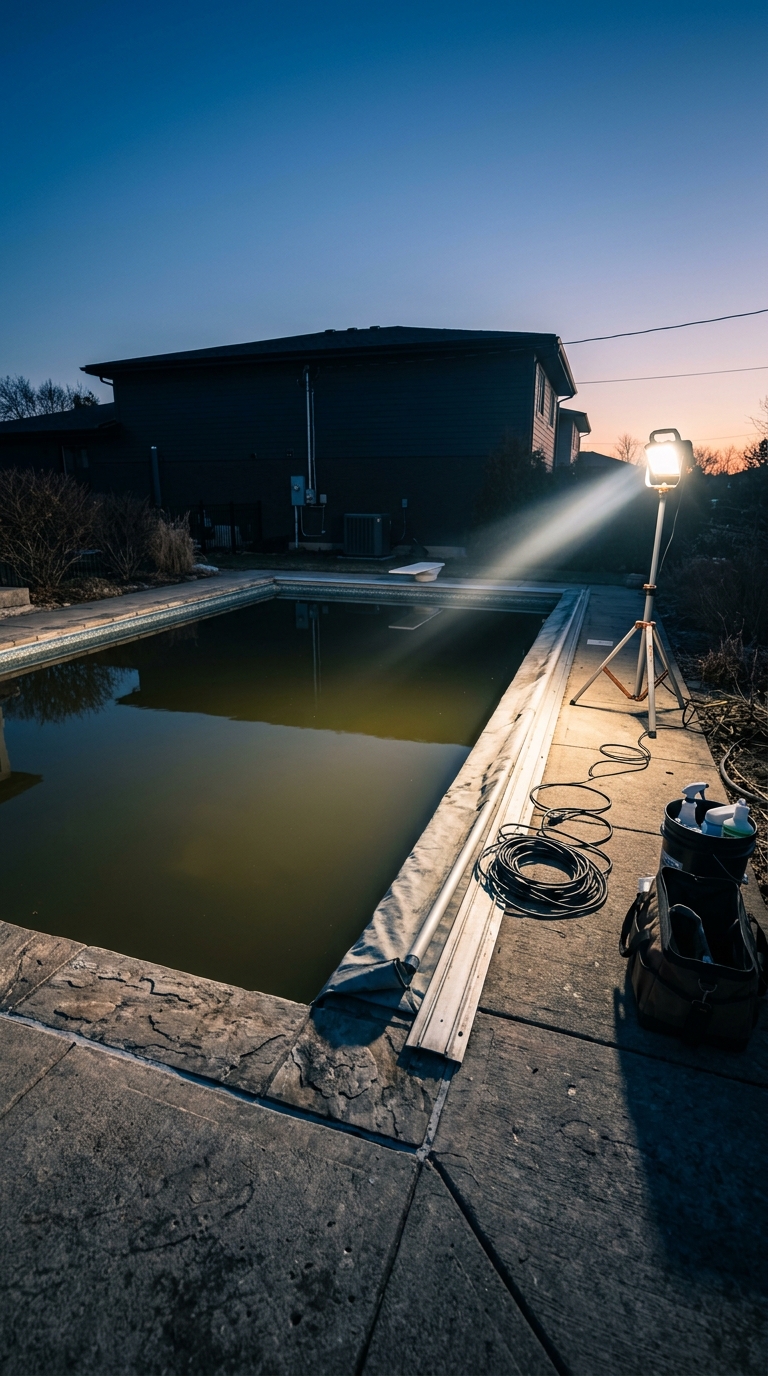
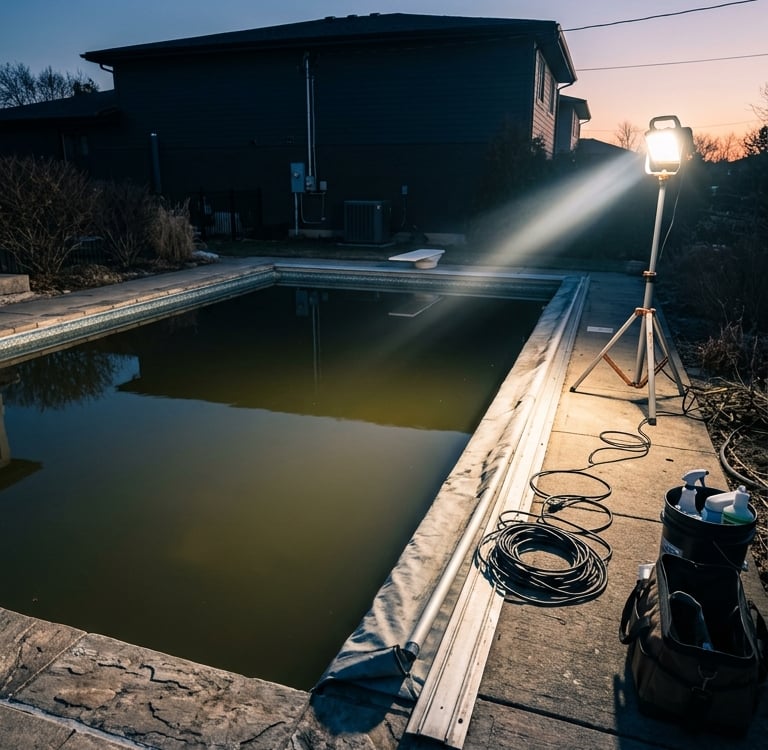
Every spring, the same scenario plays out in backyards across North America. The cover comes off, the pump goes on, and the owner stares at a pool full of green, cloudy, chemically unknown water and reaches for the shock. Then the algaecide. Then the clarifier. Then the pH kit. Then the phone to call the pool store. Three products and two weeks later the water is finally clear, but the chemistry is still unstable, the equipment has been running against elevated back-pressure the entire time, and the household has lost most of the early swimming season to a startup that should have taken 48 hours.
Pool opening is not complicated. It fails when it is treated as a reactive process — add chemicals until the water looks right — rather than a systematic protocol that establishes the correct chemical foundation in the correct sequence before anything can go wrong.
The water in your pool at the start of the season has a specific chemistry profile determined by how it was closed, what happened to it over winter, and what is in your specific tap water. You cannot correct water you have not tested, and you cannot test water you have not properly prepared for circulation. Every effective pool opening follows the same non-negotiable sequence: prepare the physical systems first, test the baseline chemistry second, correct parameters in sequence third, and apply biological protection last. Deviating from this sequence guarantees the correction cycle that costs most owners the first two weeks of the season.
This guide is the exact spring pool opening protocol our team deploys to achieve swim-ready water within 48 hours of removing the winter cover — every season.
Phase 1: Physical Preparation — Before Any Chemistry Enters the Water
The chemical startup cannot begin until the physical systems are operational and the water is circulating correctly. Chemistry added to a pool with a clogged filter, an unprimed pump, or a partially blocked return line will not distribute evenly through the water column — producing inaccurate test readings and uneven chemical treatment that forces additional correction.
The Cover Removal and Debris Extraction: Remove the winter cover carefully, preventing the accumulated debris on the cover surface from falling into the pool water. Any organic material — leaves, algae, debris — that enters the pool at opening immediately increases the biological load the sanitizer must address and contributes to the cloudiness that defines a difficult startup. Use a cover pump to remove standing water from the cover surface before folding it, and clean and store the cover dry to prevent mould growth during the swimming season.
The Waterline and Skimmer Check: Inspect the waterline around the full perimeter of the pool. If the water level dropped below the skimmer during winter, refill to the correct operating level — the midpoint of the skimmer opening — before starting the pump. Running the pump with the water level below the skimmer introduces air into the system, which can damage the pump seal and produce cavitation that reduces circulation efficiency throughout the startup process.
The Equipment Inspection: Before starting the pump, inspect the filter for any cracking, damage, or excessive debris loading from the winterization. Reinstall any drain plugs, return fittings, and skimmer baskets that were removed for winterization. Check the pump basket and clear any debris before priming. Start the pump and confirm that all return jets are producing flow and that the filter pressure gauge is reading within the normal operating range for your system. An unusually high pressure reading at startup indicates a filter that needs to be cleaned or backwashed before it can circulate the startup chemistry effectively.
The Circulation Period: Allow the pump and filter system to run for a minimum of two hours before taking any water test. This initial circulation period distributes the water evenly through the entire pool volume, brings the temperature reading to equilibrium, and flushes any stagnant water from the plumbing lines into general circulation. A water sample pulled before this circulation period has completed will not represent the actual bulk chemistry of the pool and will produce misleading baseline readings.
Phase 2: The Baseline Chemistry Audit
With the physical systems operational and the water fully circulated, execute a complete baseline test across all parameters before opening a single chemical container. Every chemical decision in the startup sequence must be driven by actual test data — not by what the water looked like last season, not by what the pool store recommends as a generic startup dose, and not by how the water looks or smells. Add chemistry to water you have not tested and you are working blind.
The Seven-Parameter Baseline: Pull your test sample from the centre of the pool at elbow depth — approximately 18 inches below the surface — and away from any return jet or skimmer intake. Record every parameter reading before proceeding: Free Chlorine, Total Chlorine, pH, Total Alkalinity, Calcium Hardness, Cyanuric Acid, and phosphates if your test kit covers them. This baseline record is the map that determines which parameters need correction, in what direction, and in what sequence.
The Startup Target Parameters:
Total Alkalinity: 80 to 120 ppm — correct first
pH: 7.4 to 7.6 — correct second
Calcium Hardness: 200 to 400 ppm — correct third
Cyanuric Acid: 30 to 50 ppm — correct fourth
Free Chlorine: 1 to 3 ppm — add last
Phosphates: below 200 ppb — treat if elevated before adding sanitizer
The Sequence Rule: The correction sequence is non-negotiable. Alkalinity stabilizes pH. pH governs sanitizer effectiveness. Hardness governs surface and equipment protection. CYA governs how long your chlorine survives UV exposure. Sanitizer added before any of these are in range is either ineffective, wasted, or both.
Phase 3: The Chemical Startup Sequence
The Pool Opening Enzyme Dose: Before any balancing chemistry, add a pool opening enzyme treatment to the water with the pump running. This product is not a sanitizer, a pH corrector, or a shock — it is an enzyme-based formula that begins breaking down the organic debris, oils, and winterization residue accumulated in the water over the closed season. Organic load suppresses sanitizer efficiency and drives pH instability. Eliminating it at the start of the startup sequence significantly reduces the amount of balancing and sanitizing chemistry required to reach and hold target parameters. Add the enzyme treatment immediately and allow it to circulate for two hours before beginning the parameter correction sequence.
Alkalinity Correction: Using the baseline test data, calculate the dose of alkalinity increaser required to bring total alkalinity to the 80 to 120 ppm target range. Add in increments — never dump the full calculated dose at once. Circulate for 30 minutes and retest before adding more. Small sequential corrections are always more efficient than a single large dose that overshoots the target and requires an acid addition to bring back down.
pH Correction: Once alkalinity is confirmed within range, correct pH to the 7.4 to 7.6 window using pH increaser or pH decreaser as the baseline test indicates. Most pools coming out of winter have elevated pH from the alkalinity of winter precipitation — pH decreaser is the more common first-season correction. Add in small increments with 20-minute circulation intervals between additions and retests.
Calcium Hardness and CYA: Correct calcium hardness if below 200 ppm by pre-dissolving calcium hardness increaser in a bucket of warm water before adding slowly around the pool perimeter. Add cyanuric acid stabilizer to the skimmer with the pump running if CYA tests below 30 ppm — CYA dissolves slowly and may take 24 to 48 hours to fully register on a test. Do not add the startup chlorine dose until the CYA reading has stabilized, as chlorine added without adequate CYA will be destroyed by UV within hours in an outdoor pool.
The Startup Shock: With all parameters confirmed within range, add the startup shock and sanitizer dose. Use the pool opening kit's shock product at the dose specified for your pool volume. Execute the shock dose in the evening after the sun has been off the pool surface — this prevents UV from destroying a significant percentage of the chlorine before it has had time to circulate through the full water volume and begin its work.
The Pool Opening Starter Treatment: Add the pool opening starter chemical after the shock dose has had four hours to circulate. This enzyme and clarifier combination product treats the residual organic debris and winterization residue that the initial enzyme dose began breaking down, binds fine suspended particles for filter extraction, and supports the chemistry stabilization cycle in the 24 to 48 hours following the initial shock. Run the pump continuously for the first 24 hours of the startup sequence.
The Expert Gear List
To execute this complete pool opening protocol, our team deploys the following products. All items are available on Amazon.
Disclosure: The Retrofit Routine is a participant in the Amazon Services LLC Associates Program. As an Amazon Associate, we earn from qualifying purchases at no additional cost to you.
Pool Opening Chemistry
AquaDoc Pool Opening Kit — for 15,000 to 20,000 Gallon Pools: A complete pool opening chemical system containing algaecide, clarifier, shock, stain and scale remover, and test strips — everything required to execute the full startup protocol without sourcing individual products from multiple brands. Designed for the 15,000 to 20,000 gallon residential pool volume range. The single-purchase solution for pool owners who want a unified startup system that addresses biological control, water clarity, and parameter stabilization in a coordinated sequence from day one.
AquaDoc Pool Opening Chemical — 16oz (up to 15,000 gallons): An enzyme-based pool opening treatment that breaks down the accumulated oils, organic debris, and winterization residue in the water column at the start of the season — before balancing chemistry is added. Reduces the sanitizer demand created by organic load, supports clarity, and improves the efficiency of the startup shock and parameter correction sequence. Available in 16oz for pools up to 15,000 gallons.
Also available in 32oz for larger pools:
Contact
Questions? Reach out anytime, we’re here.
© 2026. All rights reserved.
Disclosure
The Retrofit Routine is a participant in the Amazon Services LLC Associates Program. As an Amazon Associate, we earn from qualifying purchases at no additional cost to you.
The Retrofit Routine is a digital property owned and operated by Atlantic Delivery Drivers Corp.