
The Pool Water Clarity Protocol: Clarifier vs. Flocculant — Diagnosing and Clearing Cloudy Pool Water the Right Way
Cloudy pool water is not one problem — it is three different problems that each require a different solution. Get the exact diagnosis framework, clarifier deployment protocol, and flocculant emergency reset sequence that clears your pool permanently rather than temporarily masking the symptom.
THE ROUTINE
7 min read
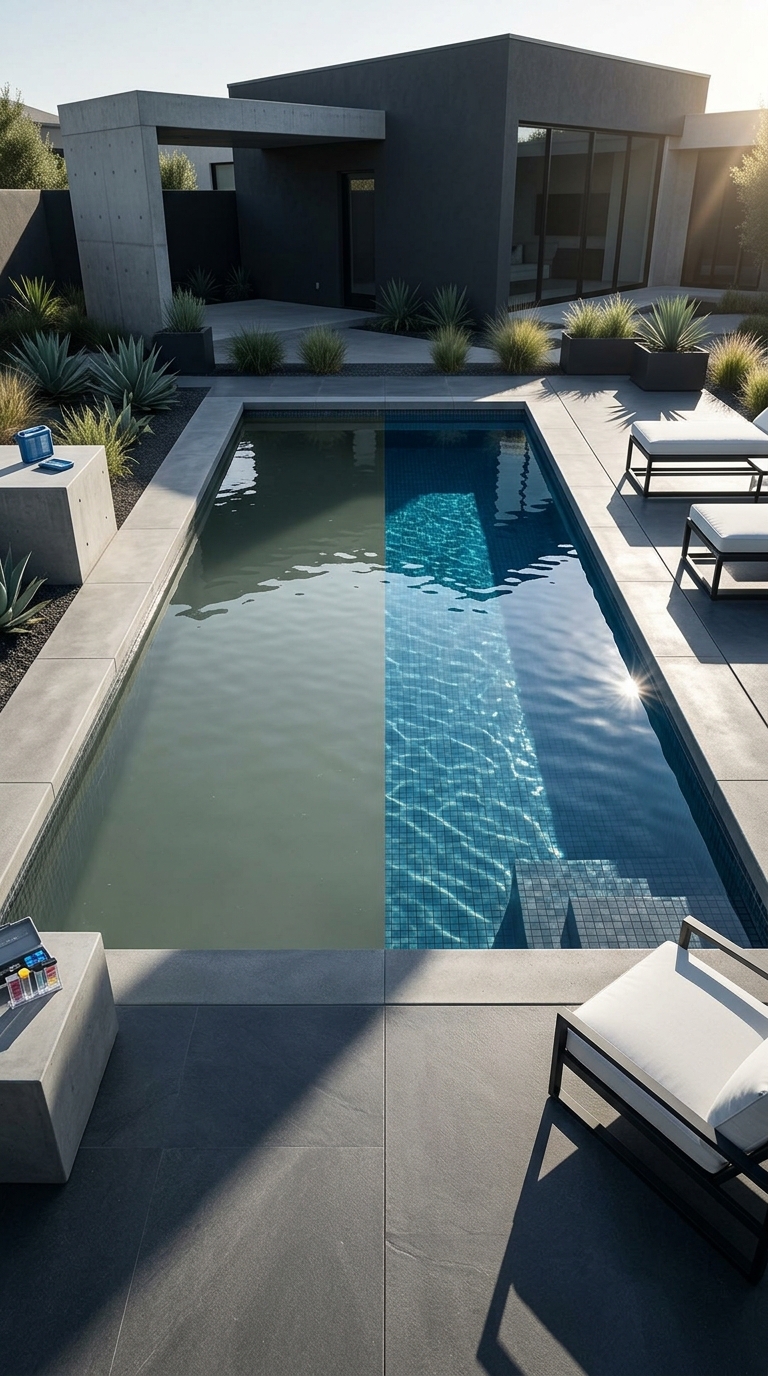
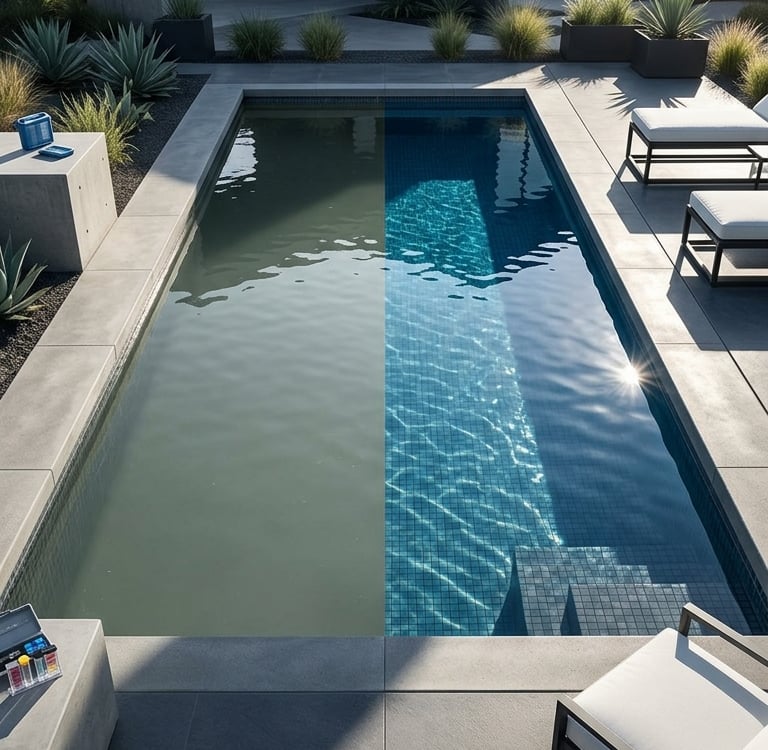
Cloudy pool water is the most common and most misdiagnosed problem in residential pool management. Most owners reach for shock the moment the water loses clarity — and when the shock does not clear it within 24 hours, they add clarifier. When the clarifier does not produce immediate results, they add algaecide. Three products later, the water is still cloudy, the chemistry is now overloaded with dissolved solids, and the pool store visit has become unavoidable.
The reason this cycle repeats is that cloudy water is not a single problem with a single solution. It is a symptom that can have three completely different causes — each of which requires a different response. Shocking water that is cloudy from a filtration failure will not clear it. Adding clarifier to water that is cloudy from a chemistry imbalance will not clear it. The only way to break the cloudy water cycle permanently is to correctly identify which of the three causes is driving the problem before any product is added.
This guide is the complete pool water clarity protocol — the diagnostic framework that identifies the source of the cloudiness, the clarifier deployment system for fine particle cloudiness that the filter cannot capture on its own, and the flocculant emergency reset procedure for severe cloudiness events that require a complete particle purge rather than a filtration assist.
Phase 1: The Clarity Diagnostic — Identifying the Source Before Treating the Symptom
Every clarity problem in a residential pool has one of three root causes. Identifying which one is driving your specific cloudiness before adding any product is what separates a 24-hour resolution from a two-week correction cycle.
Cause 1 — Chemistry Imbalance: The most common cause of sudden cloudiness in an otherwise well-maintained pool is a chemistry parameter that has drifted out of range. High pH is the single most common driver — at pH above 7.8 calcium carbonate precipitates out of solution and the dissolved minerals that were invisible in balanced water become suspended white particles that scatter light and produce the milky, hazy appearance that reads as cloudiness. High calcium hardness combined with high pH accelerates this precipitation dramatically. Algae at its earliest stage — before any visible green colour — also produces a flat, dull, slightly hazy appearance that owners frequently mistake for chemistry cloudiness.
The Chemistry Cloudiness Test: Pull a full seven-parameter test immediately. If pH is above 7.8 or total alkalinity is above 120 ppm, chemistry cloudiness is the cause. Correcting the parameter will allow the precipitated particles to re-dissolve and the water will clear within 12 to 24 hours of running the filter. Adding clarifier to chemistry cloudiness does not address the cause and will produce a temporary visual improvement that returns as the chemistry continues to drive precipitation.
Cause 2 — Filtration Failure: Fine suspended particles — dead algae after a shock treatment, fine dirt from a storm, environmental debris, cosmetic residue from heavy bather load — are too small to be captured by the filter media and pass through the filtration loop continuously without being removed from the water. The water tests correctly on all chemistry parameters but remains persistently hazy or dull. This is the classic clarifier scenario — fine particles that the filter cannot capture on its own need to be coagulated into larger clusters that the filter media can then remove.
The Filtration Cloudiness Test: If the chemistry test returns all parameters within range and the water is still cloudy, run the filter for 24 hours continuously and retest. If clarity has not improved despite correct chemistry and continuous filtration, the particles are too fine for the filter to capture — this is the scenario a clarifier is designed to address.
Cause 3 — Severe Contamination Event: Heavy rainfall introducing significant organic load, a major algae bloom following a period of low sanitizer levels, or a large debris event that overwhelmed both the filtration system and the chemistry can produce cloudiness so severe that the normal filtration-assist approach of a clarifier will require days to produce visible results. The water is opaque rather than hazy, visibility is severely limited, and the filter pressure is rising rapidly as it attempts to capture the particle load. This is the flocculant scenario — a chemical that coagulates all suspended particles and drops them to the floor simultaneously for manual vacuuming, clearing the water in hours rather than days.
Phase 2: The Clarifier Protocol — Filtration Assist for Fine Particle Cloudiness
A pool clarifier is a coagulant — a positively charged polymer that attracts the negatively charged fine particles suspended in the water and binds them together into larger clusters that the filter media can capture and remove. Used correctly it is the fastest and least disruptive solution for fine-particle cloudiness in water with correct chemistry. Used incorrectly — overdosed, applied to the wrong type of cloudiness, or applied to a dirty filter — it can temporarily worsen the cloudiness and produce a gelatinous coating on the filter media that reduces filtration efficiency.
The Pre-Clarifier Checklist: Before adding any clarifier, confirm three conditions. First, the chemistry is within range — pH 7.4 to 7.6, alkalinity 80 to 120 ppm, free chlorine 1 to 3 ppm. Clarifier applied to water with out-of-range chemistry will produce temporary improvement followed by recurrence as the chemistry continues driving the underlying cause. Second, the filter is clean — backwash or rinse the filter before the clarifier dose so the coagulated particles captured from the water have a clean media bed to be trapped in. A dirty filter will have limited capacity to capture the additional particle load the clarifier generates. Third, the pump is running and will continue running for a minimum of 8 hours after the clarifier dose — the coagulation and capture cycle requires continuous circulation.
The Clarifier Application: Add the natural pool clarifier at the dose specified on the product for your pool volume with the pump running. Distribute the dose by pouring it in front of the return jets to allow the circulation to distribute it evenly through the water column. Do not add clarifier near the skimmer — coagulated particles entering the skimmer before they have been captured by the filter will coat the skimmer basket and reduce flow rate. Run the pump continuously for 8 to 12 hours and avoid swimming during this period — bather disturbance disrupts the coagulation process and reduces the clarifier's effectiveness.
The 24-Hour Assessment: After 24 hours of continuous filtration following the clarifier dose, assess the water clarity. In most fine-particle cloudiness scenarios the water will have cleared significantly or completely. If clarity has improved but the water is not fully clear, a second maintenance dose at half the initial rate will complete the coagulation cycle. If there has been no visible improvement after 24 hours of continuous filtration, the cloudiness has a cause that clarifier cannot address — return to the diagnostic phase and retest chemistry before proceeding.
The Natural vs. Synthetic Clarifier Distinction: Natural enzyme-based pool clarifiers work through a combination of enzymatic digestion of organic compounds and coagulation of fine inorganic particles. They are safe for all pool surfaces, all sanitizer systems, and all filter types including cartridge filters where traditional synthetic clarifiers can produce the gelatinous coating issue. For pools with cartridge filtration or salt systems, a natural clarifier is the correct product choice. Synthetic polymer clarifiers work faster in severe fine-particle scenarios but require careful dosing to avoid filter media coating.
Phase 3: The Flocculant Protocol — Emergency Particle Purge for Severe Cloudiness
Flocculant operates on a fundamentally different principle from clarifier. Where a clarifier coagulates particles into filter-capturable clusters, a flocculant coagulates all suspended particles into large heavy masses that sink to the floor of the pool — removing them from suspension through gravity rather than through filtration. The result is rapid, dramatic clarity restoration in situations where clarifier would require days. The tradeoff is that the flocculated material on the pool floor must be vacuumed out manually — it cannot be run through the filtration system without clogging the filter.
When Flocculant Is the Correct Choice: Use flocculant when the water is so severely cloudy that visibility is limited to less than 12 inches — you cannot see the bottom of the shallow end, the return jets are barely visible, or the water has a distinctly opaque rather than hazy appearance. Flocculant is also the correct choice when a clarifier has been running for 24 hours without measurable improvement, when the filter pressure is rising rapidly from particle loading, or when a time-sensitive event — a party, a holiday weekend, guests arriving — requires the fastest possible restoration of clear water.
The Flocculant Procedure: Lower the water level by approximately 6 inches before applying flocculant to provide capacity for the settled material without the pool overflowing during the vacuum-out process. Set the filter to recirculate mode — not filter mode — before adding the flocculant. Running flocculant through the filter media will clog the system. In recirculate mode the pump circulates water through the plumbing without passing it through the filter media. Add the flocculant at the dose specified for your pool volume with the pump running in recirculate mode, allowing full circulation for the dwell time specified on the product — typically 2 hours. After the dwell period, turn the pump completely off and allow the pool to sit undisturbed for 8 to 12 hours — overnight is standard. The flocculated material will settle to the floor as a visible white or grey layer.
The Vacuum-Out: After the settling period, vacuum the pool floor on the waste setting — vacuuming to filter will push the flocculated material through the filter and back into the water. Vacuum slowly and methodically from one end to the other, avoiding any turbulence that re-suspends the settled material. The water will cloud temporarily in the area being vacuumed as disturbed material is drawn up — work slowly and the clarity will improve behind each pass. After completing the vacuum, restore the filter to its normal operating setting, refill the pool to the correct waterline, and execute a full chemistry test. The chemistry will have been diluted by the water level reduction and the water that was vacuumed out — rebalance all parameters before restoring normal sanitizer levels.
The Expert Gear List
To execute the complete pool water clarity protocol for both routine fine-particle cloudiness and severe contamination events, our team deploys the following products. All items are available on Amazon.
Disclosure: The Retrofit Routine is a participant in the Amazon Services LLC Associates Program. As an Amazon Associate, we earn from qualifying purchases at no additional cost to you.
Pool Clarifier
AquaDoc Natural Pool Water Clarifier — 64oz: A natural enzyme-based pool clarifier that clears cloudy pool water by coagulating fine suspended particles into filter-capturable clusters. Safe for all pool surfaces, all sanitizer systems, and all filter types including cartridge and sand filtration. The correct weekly maintenance clarifier for residential pools experiencing fine-particle cloudiness from bather load, environmental debris, and post-shock dead algae. Natural formula will not coat cartridge filter media.
Also available in smaller format:
Pool Flocculant
AquaDoc Swimming Pool Flocculant — 32oz: A professional-strength pool flocculant engineered for severe cloudiness events where standard clarification requires days. Binds all suspended particles into heavy masses that sink to the pool floor for manual vacuum removal, restoring water clarity in hours rather than days. The correct tool for post-algae-bloom recovery, post-storm debris events, and any situation where the water is too cloudy to address through normal filtration-assist clarification. Requires vacuuming to waste after settling — not for use with filter running on filter mode.
Contact
Questions? Reach out anytime, we’re here.
© 2026. All rights reserved.
Disclosure
The Retrofit Routine is a participant in the Amazon Services LLC Associates Program. As an Amazon Associate, we earn from qualifying purchases at no additional cost to you.
The Retrofit Routine is a digital property owned and operated by Atlantic Delivery Drivers Corp.