
The Pool Water Testing Protocol: How to Read Your Pool Chemistry With Precision and Never Guess Again
Every pool chemistry failure starts the same way — someone added a chemical without knowing what the water actually needed. Get the exact digital testing protocol, weekly cadence, and seven-parameter correction sequence that keeps your pool permanently balanced through the full swimming season.
THE ROUTINE
8 min read

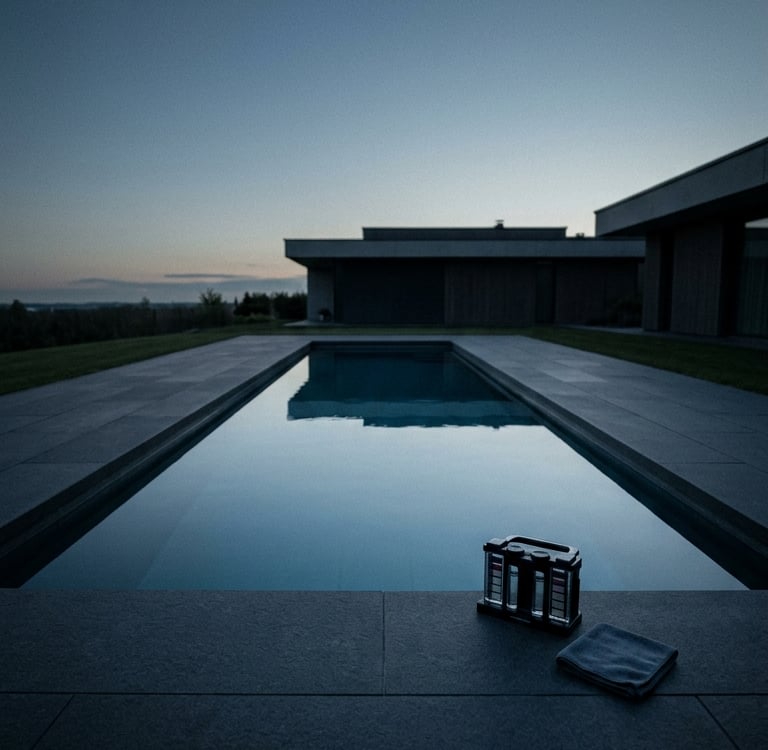
A backyard pool is one of the most chemically dynamic environments a household manages. The water chemistry shifts daily in response to bather load, UV exposure, rainfall, temperature, and every chemical addition you make to correct the previous imbalance. Most pool owners interact with this system reactively — the water turns cloudy, the eyes start burning, or the pool store hands back a printout after dipping a strip — and by that point the chemistry has already failed, the equipment has already been running under stress, and the correction costs significantly more than prevention would have.
The fundamental problem is not the pool. It is the testing approach. Colour-matching a test strip under uncertain lighting conditions and comparing it to a printed chart produces approximate readings at best. Approximate readings drive approximate chemistry decisions. Approximate chemistry decisions produce approximate results — which is why most residential pools cycle through the same instability patterns week after week regardless of how conscientiously the owner manages them.
Precision pool management requires precise data. A digital water testing system that reads all seven critical parameters simultaneously and returns exact numerical values eliminates the interpretation variable entirely. When you know that your free chlorine is 0.8 ppm, your pH is 7.9, and your cyanuric acid is 22 ppm simultaneously, the correction sequence is obvious and exact. When you are colour-matching three separate strips and estimating where each sits on a gradient scale, you are making chemistry decisions from inaccurate data and wondering why the results are inconsistent.
This guide is the complete pool water testing protocol — what to measure, when to measure it, how to pull a representative sample, and the weekly testing cadence that keeps every parameter within range before any of them have the opportunity to drive a correction cycle.
Phase 1: The Seven Parameters — What Your Pool Water Is Actually Telling You
A complete pool water test covers seven distinct parameters. Each one governs a specific aspect of water safety, swimmer comfort, or equipment protection. Understanding what each parameter measures and how it interacts with the others is what separates a pool owner who manages chemistry from one who chases it.
Free Chlorine: The active sanitizer concentration in the water right now. This is the number that tells you whether your pool is biologically protected at this moment. Free chlorine below 1 ppm in an outdoor residential pool means the water has insufficient active sanitizer regardless of what you added three days ago. UV exposure, bather load, and organic contamination consume free chlorine continuously. Target range is 1 to 3 ppm — maintain it in this window and your pool is protected. Allow it to drop below 1 ppm and bacteria and algae have an uncontested growth window. Target: 1 to 3 ppm.
Total Chlorine: The combined reading of your free chlorine and your combined chlorine — the chloramines formed when free chlorine reacts with organic bather waste including sweat, sunscreen, and body oils. The gap between total chlorine and free chlorine is your combined chlorine level. A widening gap is not a sign that you need more chlorine — it is a direct indicator that the water needs to be shocked to oxidize the accumulated chloramines. The sharp chemical smell most swimmers associate with over-chlorinated pools is chloramines, not free chlorine. Target: total chlorine reading close to free chlorine reading, with minimal gap.
pH: The master variable that governs the effectiveness of every other chemical in the system. At pH above 7.8, free chlorine effectiveness drops dramatically — at pH 8.0 your chlorine is operating at less than 20% of its rated effectiveness regardless of the concentration reading. At pH below 7.2, water becomes corrosively aggressive, etching plaster and grout, corroding metal fittings, and causing skin and eye irritation. The 7.4 to 7.6 window is where chlorine operates at maximum efficiency and where the water is gentlest on every surface and bather it contacts. Target: 7.4 to 7.6.
Total Alkalinity: The chemical buffer that stabilizes pH against the rapid swings caused by rainfall, bather load, and chemical additions. Low alkalinity produces the pH bounce pattern — pH swings up after a use session and crashes down after a chemical addition, never holding stable long enough to maintain correct sanitizer efficiency. High alkalinity makes pH resistant to correction and contributes to scale formation on pool surfaces and equipment. Alkalinity is always corrected before pH in every correction sequence because alkalinity stability is what makes pH correction hold. Target: 80 to 120 ppm.
Calcium Hardness: The mineral content of the water that determines whether it is scale-forming or surface-aggressive. Water with calcium hardness below 200 ppm is chemically undersaturated — it will pull calcium from wherever it can find it, which in a pool means the plaster, the grout, the tile, and the metal fittings. This etching is invisible in the short term and accumulates into permanent surface damage over seasons. Water with calcium hardness above 400 ppm deposits calcium scale on surfaces, tile lines, and the interior of the heater — scale on the heater element reduces heating efficiency and eventually causes element failure. Target: 200 to 400 ppm.
Cyanuric Acid: The stabilizer that protects your free chlorine from UV degradation in an outdoor pool. Without adequate cyanuric acid, direct sunlight destroys the majority of your free chlorine within hours of addition — a pool in direct summer sun with zero CYA can lose its entire chlorine reading in under four hours. Without knowing your CYA level, every outdoor pool chlorine dosing decision is built on an unknown variable. CYA also has an upper limit — above 80 ppm it begins suppressing the effectiveness of the chlorine it is supposed to protect, a condition known as chlorine lock. Target: 30 to 50 ppm.
Bromine: Relevant for pools using bromine rather than chlorine as the primary sanitizer, and for any household testing a shared pool and spa system. Target: 3 to 5 ppm for bromine-sanitized pools.
Phase 2: Digital Tester vs. Test Strips — The Right Tool for Each Scenario
A complete pool testing system uses both instruments. They are not interchangeable and each has a specific role in a well-managed testing protocol.
The Digital Water Tester — The Weekly Anchor Test: A digital tester analyses a collected water sample and returns exact numerical readings across all seven parameters simultaneously. There is no colour matching, no ambient lighting variable, no interpretation. The reading is either 7.4 or 7.6 — not somewhere in the medium-blue-green range that could be either. This is the instrument for the weekly anchor test — the primary data collection event that drives all major chemistry decisions for the following seven days. The investment in a quality digital tester pays for itself within a single season by eliminating the overcorrection cycles that imprecise strip readings produce.
Test Strips — The Mid-Week Spot Check: Test strips are the correct instrument for fast mid-week checks on one or two parameters after a heavy use session or a significant rainfall event. They deliver a directional result — is the chlorine up or down, did the pH shift — in 30 seconds without the sample collection and rinse protocol the digital tester requires. Used as a supplementary instrument alongside the digital tester, they extend your testing frequency without adding meaningful time to your maintenance routine. Used as a replacement for digital testing, they introduce the interpretation variables that produce the inconsistent chemistry outcomes most pool owners experience as normal.
Phase 3: The Sampling Protocol — Why Where and When You Test Matters
The accuracy of any water test is only as good as the sample. A sample pulled from the wrong location, at the wrong time, or in a contaminated container will return readings that do not reflect the actual chemistry of the bulk water — driving chemistry decisions based on false data.
Sampling Location: Always pull your test sample from the centre of the pool at elbow depth — approximately 18 inches below the surface. Never sample near a return jet where the chemistry is concentrated from the circulation system. Never sample near the skimmer intake where the chemistry is depleted as water enters the filtration loop. Never sample in shallow water near the steps where the chemistry is diluted by proximity to the surface. The centre of the pool at elbow depth gives you the most representative reading of the actual bulk water chemistry.
Sampling Time: Execute the weekly anchor test in the early morning before the sun has been on the pool for more than an hour and before any bather use that day. UV exposure actively degrades free chlorine throughout the day — a midday sample in a pool without adequate cyanuric acid stabilizer will show a significantly lower free chlorine reading than an early morning sample from the same pool, and will cause you to overdose chlorine that the UV then destroys before it can do any useful work. Morning readings before use give you the water's true resting chemistry baseline.
The Sample Container: Use a clean, dry container specifically designated for pool testing. Never use a container that previously held chemicals, cleaning products, or any substance that could contaminate the sample and corrupt the readings. Rinse the sample container with pool water twice before pulling the final sample for testing.
Post-Addition Wait Time: After adding any chemistry, circulate the pump for a minimum of 30 minutes before pulling a test sample to verify the result. Testing immediately after addition returns readings from a chemically uneven water column. The 30-minute circulation minimum ensures the added chemistry has distributed through the full pool volume before the verification test is executed.
Phase 4: The Testing Cadence — Building the Weekly Protocol
A testing protocol is only as useful as the consistency with which it is executed. Irregular testing produces irregular data, which produces irregular chemistry, which produces the unpredictable water quality that most pool owners accept as the normal experience of pool ownership.
The Weekly Anchor Test: Execute a full seven-parameter digital test on the same day each week throughout the swimming season. Record every reading before making any chemistry adjustment. The log is how you identify the patterns that drive efficient chemistry management — a pool that consistently shows alkalinity drift in one direction tells you something specific about your fill water or your chemical additions. A pool that consistently shows pH rise after heavy use tells you something specific about your bather load profile. Patterns identified from a consistent testing log allow you to get ahead of the chemistry rather than responding to it.
The Post-Rain Test: Rainfall dilutes cyanuric acid, alkalinity, and calcium hardness while simultaneously introducing organic contamination and atmospheric nitrogen compounds that consume free chlorine and drive pH changes. After any significant rainfall — more than half an inch — execute a full digital test regardless of where you are in the weekly cycle. Do not wait for the scheduled anchor test. Post-rain chemistry shifts are the most common trigger for the rapid deterioration that turns a clear pool cloudy within 48 hours.
The Post-Heavy-Use Spot Check: After any pool session involving five or more swimmers, execute a test strip check on free chlorine and pH within two hours of the session ending. Heavy bather load drives rapid free chlorine consumption and pH rise. A quick spot check tells you whether a maintenance dose of sanitizer is needed before the next session rather than discovering the deficit at the following morning's anchor test when the water has already had overnight to develop the conditions for algae and bacterial growth.
The Pre-Season Baseline: At pool opening, execute the full seven-parameter digital test as the first step of the startup protocol before adding any chemistry. Winter conditions shift every parameter in ways that vary by region, cover type, and closing chemistry. Starting from actual measured data rather than assumptions from the previous season eliminates the overcorrection cycle that consumes the first two weeks of the swimming season.
The Expert Gear List
To execute a complete pool water testing protocol with the precision required to keep seven interdependent parameters in range through a full swimming season, our team deploys the following instruments. All items are available on Amazon.
Disclosure: The Retrofit Routine is a participant in the Amazon Services LLC Associates Program. As an Amazon Associate, we earn from qualifying purchases at no additional cost to you.
Digital Testing System
Eagle Ray Digital Pool Water Test Kit by AquaDoc: The exact digital testing system this protocol is built around. Reads all seven critical pool water parameters — Free Chlorine, Total Chlorine, Bromine, Total Hardness, Cyanuric Acid, Total Alkalinity, and pH — simultaneously from a single water sample. Returns exact numerical values in seconds, eliminating the colour-matching interpretation that produces the imprecise readings driving most pool chemistry instability. Comes with 30 pool test strips for mid-week spot checks. At $174.99 this instrument replaces years of pool store testing fees and the overcorrection costs that imprecise strip-only testing consistently produces.
Test Strips
AquaDoc 7-in-1 Spa & Hot Tub Test Strips — 200 Count: The supplementary instrument for mid-week spot checks and post-event rapid assessments between weekly digital anchor tests. Tests all seven critical parameters — Total Chlorine, Free Chlorine, Total Hardness, Cyanuric Acid, Total Alkalinity, Bromine, and pH — in a fast-result format compatible with all pool and spa types. The 200-count format provides a full season of spot-check coverage without reordering.
Also available in 100-count for lower-frequency testing:
Contact
Questions? Reach out anytime, we’re here.
© 2026. All rights reserved.
Disclosure
The Retrofit Routine is a participant in the Amazon Services LLC Associates Program. As an Amazon Associate, we earn from qualifying purchases at no additional cost to you.
The Retrofit Routine is a digital property owned and operated by Atlantic Delivery Drivers Corp.